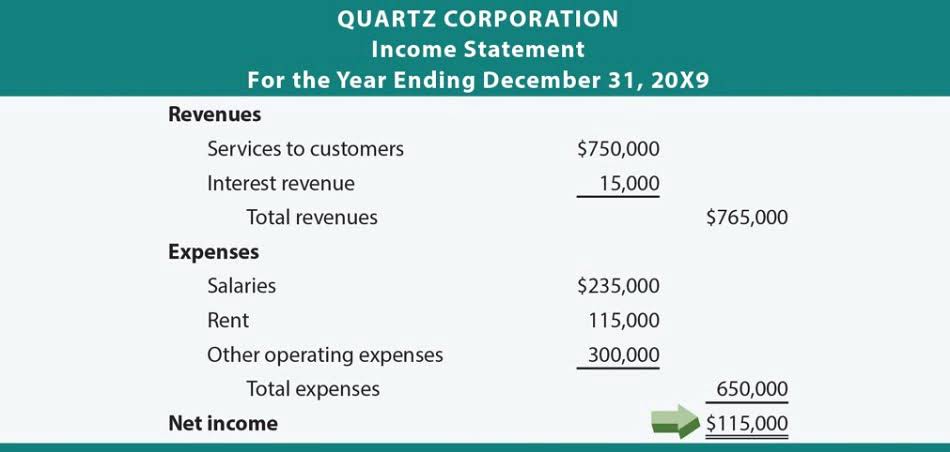

Any profits made by a business are added to the retained earnings balance and losses subtracted from it. These profits or losses are available in the Statement of Profit or Loss of the business. The profit or loss relates to the accounting period for which the statement is prepared.
- Retained earnings are the portion of a company’s net earnings that the company decides to hold as a reserve or reinvest in its own growth rather than issue as dividends in cash or shares to reward shareholders.
- Once the return is finished, the client’s software will automatically close the books (zero net income to retained earnings), and the process starts fresh the next year.
- Retained earnings provide insights into the company’s historical profitability and its ability to generate future earnings.
- Companies must ensure that their retained earnings statements are precise and up-to-date to provide stakeholders with a clear picture of the organization’s financial performance and future potential.
Create a free account to unlock this Template
When a certain amount of net income is not paid out to shareholders or reinvested back into the business, it becomes retained earnings. Mind that some companies choose to keep money in retained earnings accounts for years, so the total figure you see on some statements is a result of many years of hard work savings. Preparing financial statements it may not sound like the most exciting task. Albeit, it’s a hugely important one, especially if your company is seeking investment or planning to expand its operations. retained earnings statement Not to mention that most businesses are obliged to present a statement of retained earnings to the Tax authorities. You’ll need your financial records for the reporting period, especially your net income and any dividends issued.
Tips for Accurate Preparation
- If there are retained earnings, owners might use all of this capital to reinvest in the business and grow faster.
- Any changes or movements with net income will directly impact the RE balance.
- Under Statement No. 16, companies must exclude the effect of prior period adjustments from current financial statements since the changes have no relationship to the current statement period.
- During the year, the company declared and paid a dividend of $250,000 to its stockholders.
- Net income plays a crucial role in this statement as it directly influences the amount of retained earnings.
- As a high-growth company backed by institutional investors, our focus remains on scaling rather than generating positive retained earnings at this stage.
The accountant must then proceed through each remaining balance sheet account to record the AJE and plug to retained earnings. A retained earnings statement tells you how much you’re reinvesting in your business after you’ve paid your shareholders. It’s the magic number that tells you how much you have on hand to invest in growth and running your daily operations. All you need is your net income, your previous retained earnings, and the formula. Scenario 1 – Bright Ideas Co. starts a new accounting period with $200,000 in retained earnings. After the accounting period ends, the company’s board of directors decides to pay out $20,000 in dividends to shareholders.
Is retained earnings the same as net profit?
- But several financial statements need to be prepared to calculate retained earnings.
- As mentioned before, the RE of the period being discussed can be found in the Balance Sheet, or in its own retained earnings statement.
- The balance sheet serves as a vital tool for evaluating the company’s liquidity, solvency, and overall financial health, providing stakeholders with essential information for decision-making and analysis.
- Net income and retained earnings may have distinctive differences, but both play a pivotal role in allowing financial professionals to gain a better look at their company’s finances.
- These errors could be due to mistakes in recording transactions, misclassifications, or omissions.
- On the other hand, low retained earnings and larger dividend payouts point to a policy that favors keeping shareholders happy.
These restricted amounts should be disclosed in the notes to the financial statements. The beginning retained earnings are typically the ending retained earnings from the previous period. This amount can be found on the previous period’s statement of retained earnings or balance sheet. If your company has a dividend policy and you paid out dividends in that accounting period, subtract that number from net income. Learn how to create a statement of retained earnings step by step—plus the simple formula to track your business’s growth over time. The RE balance may not always be a positive number, as it may reflect that the current period’s net loss is greater than that of the RE beginning balance.

The level of retained earnings can guide businesses in making important investment decisions. If retained earnings are low, it may be wiser to hold onto the funds and use them as a financial cushion in case of unforeseen expenses or cash flow issues rather than distributing them as dividends. However, if both the net profit and retained earnings are substantial, it may be time to consider investing in expanding the business with new equipment, facilities, or other growth opportunities. Unlike net income, which can be influenced by various factors and may fluctuate significantly between periods, retained earnings offer a more consistent and reliable indicator of the business’s financial health. A strong retained earnings figure suggests that a company is generating profits and reinvesting them back into the business, which can lead to increased growth and profitability in the future.
If you’re creating a yearly statement of retained earnings, use the one from the previous year, rather than a monthly, or quarterly document version. This involves considering your revenue, expenses, any adjustments needed, and dividends paid during the month. Let’s dive into a practical example to understand how revenue and expenses work in financial statements. Imagine you run a small bookstore that sells both physical books and e-books. This calculation demonstrates how retained earnings are adjusted over each financial period, reflecting the business’s ongoing financial activity. Contrary to common misconceptions, retained earnings are not a pool of cash but an expression of how much of the company’s earnings have been reinvested in the business or kept as a reserve.
Understatement of net income
In the United States, it is required to follow the Generally Accepted Accounting Principles (GAAP). While income statements and balance sheets often grab the spotlight, this unsung hero offers powerful insights into financial health. For CEOs and CFOs, it’s more than just a report—it’s a strategic guide to leveraging profits for future investments and boosting stakeholder confidence. Retained earnings offer valuable insights into a company’s financial health and future prospects.

On January 1, 2021, Nova had 500,000 shares of $10 par value common stock and 50,000 shares of $100 par value preferred stock outstanding. The number of shares CARES Act remained unchanged throughout the year, as Nova did not make any new issues during 2021. Retained earnings reflect the cumulative amount of net income a company has retained over time, after distributing dividends.

Lastly, the cash flow statement serves as a map, guiding us through the flow of cash into, out of, and within your business. It tells you not just if money is moving but where it’s going and coming from, making it easier to plan for future needs and opportunities. The last line on the statement sums the total of these adjustments and lists the ending retained earnings balance. In other words, assume a company makes money (has net income) for the year and only Insurance Accounting distributes half of the profits to its shareholders as a distribution. The other half of the profits are considered retained earnings because this is the amount of earnings the company kept or retained. Keep track of retained earnings, net income, and equity with a complete monthly financial reporting template.